
The Book of
Numbers 19
22 verses≈ 5 min3 peopleBSB
Images are artistic interpretations.
Tap any post to go deeper
In this chapter

The Book of
22 verses≈ 5 min3 peopleBSB
Images are artistic interpretations.
Tap any post to go deeper
In this chapter
Where we are
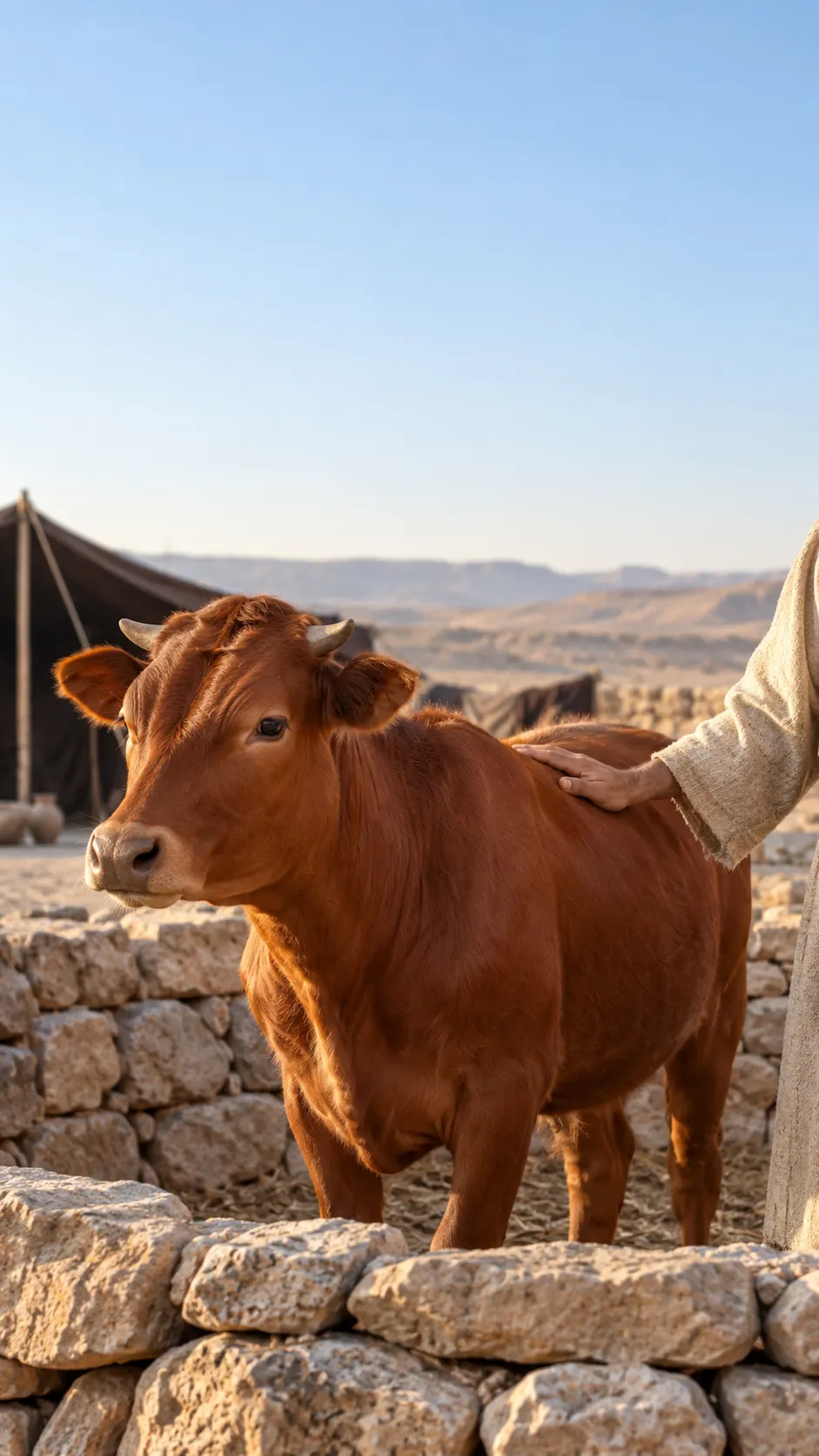
Then the LORD said to Moses and Aaron, “This is the statute of the law that the LORD has commanded: Instruct the Israelites to bring you an unblemished red heifer that has no defect and has never been placed under a yoke.
Narrated by Bob Souer · BSB audio, public domain
Tap to go deeper: meaning, history and related Scripture
Then the priest must wash his clothes and bathe his body in water; after that he may enter the camp, but he will be ceremonially unclean until evening. The one who burned the heifer must also wash his clothes and bathe his body in water, and he too will be ceremonially unclean until evening.
Then a man who is ceremonially clean is to gather up the ashes of the heifer and store them in a ceremonially clean place outside the camp. They must be kept by the congregation of Israel for preparing the water of purification; this is for purification from sin.
Numbers 19:9
The man who has gathered up the ashes of the heifer must also wash his clothes, and he will be ceremonially unclean until evening. This is a permanent statute for the Israelites and for the foreigner residing among them.
Whiteboard
Israel kept the ashes of a spotless heifer, burned outside the camp, “for purification from sin.” Sprinkled with water, they made the unclean clean again. Hebrews looks back at them: if the ashes of a heifer could cleanse the body, how much more the blood of Christ, offered without blemish, cleanses the conscience. And as the heifer was taken outside the camp, Jesus suffered outside the city gate.
Reflect
The heifer was led “outside the camp,” the place of the unclean, and there the means of cleansing was made. Hebrews says Jesus also suffered outside the city gate to make His people holy, and it calls us to go out to Him there, sharing the shame He bore. Where might following Jesus mean standing with Him outside what is comfortable or respected? Write it down. Then pray: Lord Jesus, You went outside the camp for me; give me grace to go to You there.
The law
Touch
Whoever touches any dead body will be unclean for seven days.
Cleansing
He must purify himself with the water on the third day and on the seventh day; then he will be clean. But if he does not purify himself on the third and seventh days, he will not be clean.
Warning
Anyone who touches a human corpse and fails to purify himself defiles the tabernacle of the LORD. That person must be cut off from Israel. He remains unclean, because the water of purification has not been sprinkled on him, and his uncleanness is still on him.
The tent
This is the law when a person dies in a tent: Everyone who enters the tent and everyone already in the tent will be unclean for seven days,
and any open container without a lid fastened on it is unclean.
The field
Anyone in the open field who touches someone who has been killed by the sword or has died of natural causes, or anyone who touches a human bone or a grave, will be unclean for seven days.
For the purification of the unclean person, take some of the ashes of the burnt sin offering, put them in a jar, and pour fresh water over them. Then a man who is ceremonially clean is to take some hyssop, dip it in the water, and sprinkle the tent, all the furnishings, and the people who were there. He is also to sprinkle the one who touched a bone, a grave, or a person who has died or been slain.
The man who is ceremonially clean is to sprinkle the unclean person on the third day and on the seventh day. After he purifies the unclean person on the seventh day, the one being cleansed must wash his clothes and bathe in water, and that evening he will be clean.
that evening he will be clean
Numbers 19:19
But if a person who is unclean does not purify himself, he will be cut off from the assembly, because he has defiled the sanctuary of the LORD. The water of purification has not been sprinkled on him; he is unclean.
This is a permanent statute for the people: The one who sprinkles the water of purification must wash his clothes, and whoever touches the water of purification will be unclean until evening. Anything the unclean person touches will become unclean, and anyone who touches it will be unclean until evening.”
Question
Anyone who touched the dead was unclean for seven days, and God set the days of cleansing.
On which days was the unclean person sprinkled with the water of purification?
You’ve experienced
Numbers 19
0 of 36 chapters read
A verse to carry with you
Then a man who is ceremonially clean is to gather up the ashes of the heifer and store them in a ceremonially clean place outside the camp. They must be kept by the congregation of Israel for preparing the water of purification; this is for purification from sin.
Numbers 19:9
or swipe left