The Book of
1 Kings 7
51 verses≈ 9 min2 peopleBSB
Images are artistic interpretations.
Tap any post to go deeper
In this chapter

The Book of
51 verses≈ 9 min2 peopleBSB
Images are artistic interpretations.
Tap any post to go deeper
In this chapter
Where we are
Solomon, however, took thirteen years to complete the construction of his entire palace.
Tap to go deeper: meaning, history and related Scripture
All these buildings were constructed with costly stones, cut to size and trimmed with saws inside and out from the foundation to the eaves, and from the outside to the great courtyard. The foundations were laid with large, costly stones, some ten cubits long and some eight cubits long. Above these were costly stones, cut to size, and cedar beams.
The great courtyard was surrounded by three rows of dressed stone and a row of trimmed cedar beams, as were the inner courtyard and portico of the house of the LORD.
Reflect
Solomon gave seven years to the LORD’s house and “thirteen years to complete the construction of his entire palace.” The text does not say whether that was wrong, and there may have been good reasons for it. But our calendars do show what we value. Look back over your last week: where did your time and strength go? Write down what it says, and one thing you would change.
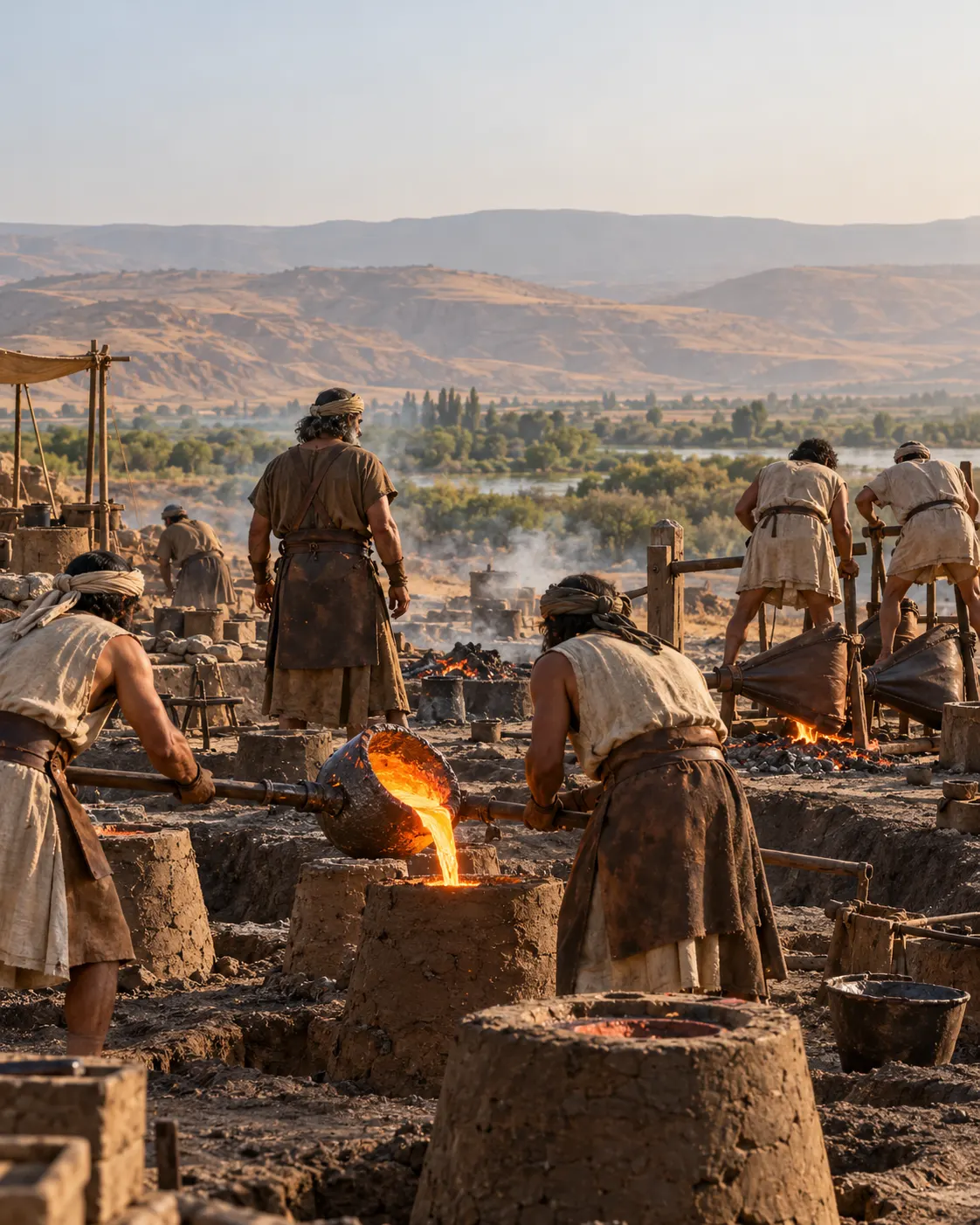
Now King Solomon sent to bring Huram from Tyre. He was the son of a widow from the tribe of Naphtali, and his father was a man of Tyre, a craftsman in bronze. Huram had great skill, understanding, and knowledge for every kind of bronze work. So he came to King Solomon and carried out all his work.
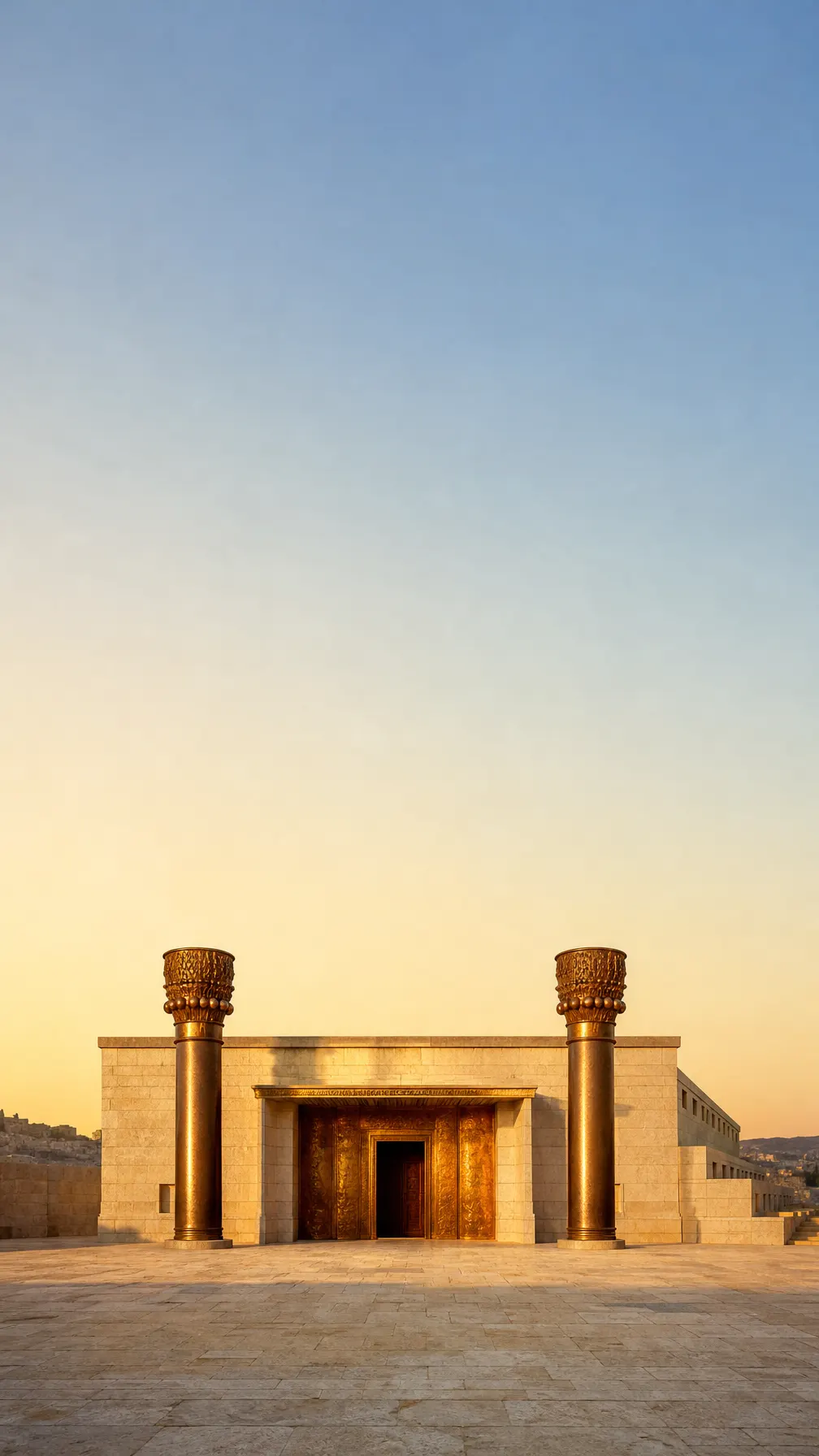
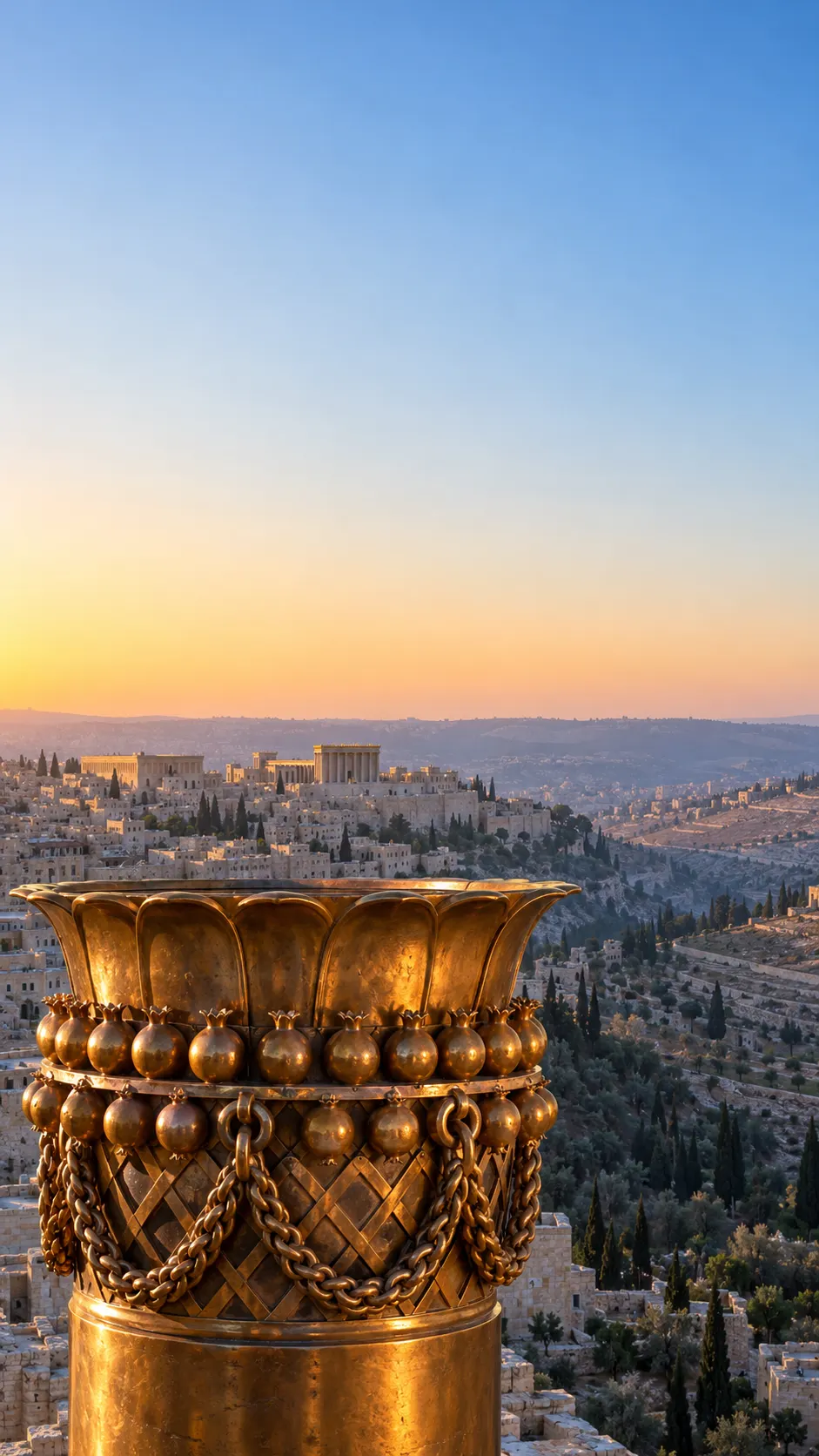
He cast two pillars of bronze, each eighteen cubits high and twelve cubits in circumference. He also made two capitals of cast bronze to set on top of the pillars, each capital five cubits high. For the capitals on top of the pillars he made a network of lattice, with wreaths of chainwork, seven for each capital.
Likewise, he made the pillars with two rows of pomegranates around each grating to cover each capital atop the pillars. And the capitals atop the pillars in the portico were shaped like lilies, four cubits high. On the capitals of both pillars, just above the rounded projection next to the network, were the two hundred pomegranates in rows encircling each capital.
Narrated by Bob Souer · BSB audio, public domain
Thus he set up the pillars at the portico of the temple. The pillar to the south he named Jachin, and the pillar to the north he named Boaz. And the tops of the pillars were shaped like lilies. So the work of the pillars was completed.
The pillar to the south he named Jachin, and the pillar to the north he named Boaz.
1 Kings 7:21
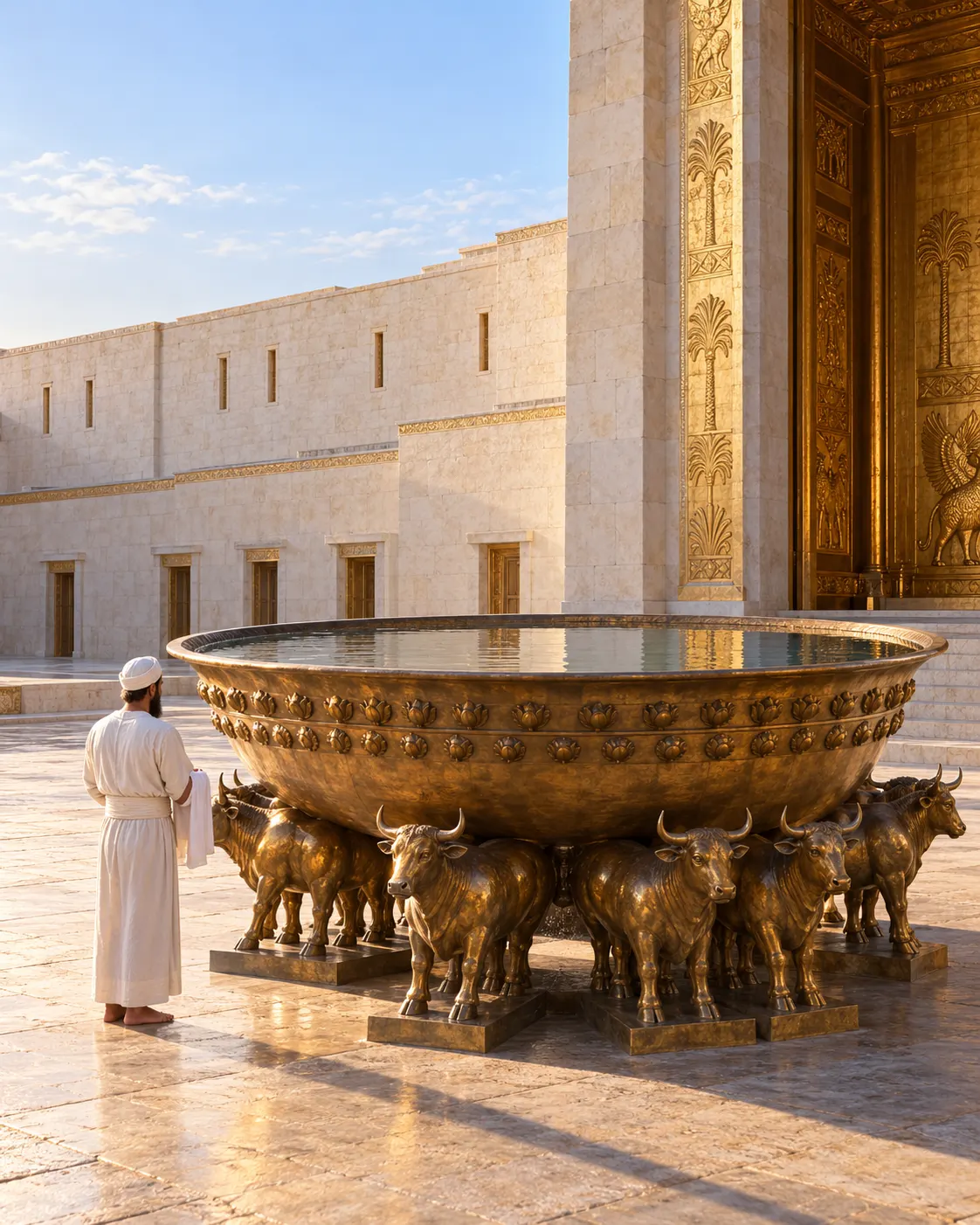
He also made the Sea of cast metal. It was circular in shape, measuring ten cubits from rim to rim, five cubits in height, and thirty cubits in circumference. Below the rim, ornamental buds encircled it, ten per cubit all the way around the Sea, cast in two rows as a part of the Sea.
Size
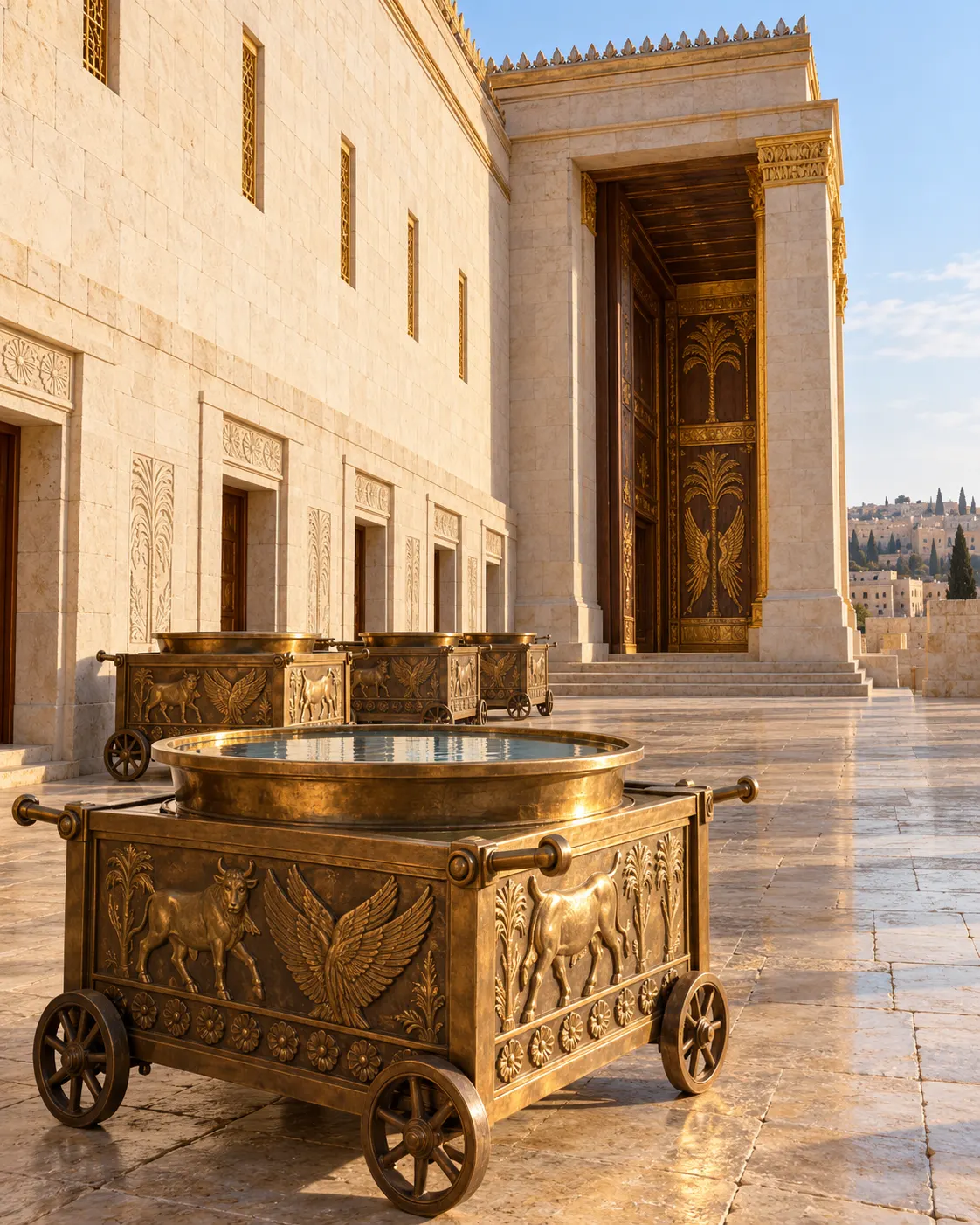
In addition, he made ten movable stands of bronze, each four cubits long, four cubits wide, and three cubits high.
The panels
This was the design of the stands: They had side panels attached to uprights, and on the panels between the uprights were lions, oxen, and cherubim.
On the uprights was a pedestal above, and below the lions and oxen were wreaths of beveled work.
Wheels
Each stand had four bronze wheels with bronze axles and a basin resting on four supports, with wreaths at each side.
The top
The opening to each stand inside the crown at the top was one cubit deep, with a round opening like the design of a pedestal, a cubit and a half wide.
And around its opening were engravings, but the panels of the stands were square, not round.
Wheels
There were four wheels under the panels, and the axles of the wheels were attached to the stand; each wheel was a cubit and a half in diameter.
The wheels were made like chariot wheels; their axles, rims, spokes, and hubs were all of cast metal.
The frame
Each stand had four handles, one for each corner, projecting from the stand.
At the top of each stand was a circular band half a cubit high.
The supports and panels were cast as a unit with the top of the stand.
Ornament
He engraved cherubim, lions, and palm trees on the surfaces of the supports and panels, wherever each had space, with wreaths all around. In this way he made the ten stands, each with the same casting, dimensions, and shape.
He also made ten bronze basins, each holding forty baths and measuring four cubits across, one basin for each of the ten stands.
He set five stands on the south side of the temple and five on the north, and he put the Sea on the south side, at the southeast corner of the temple.
Plan to scale in cubits · north at the top
Where it stood
Jachin and Boaz stood at the porch, Jachin to the south and Boaz to the north. Five stands with their basins stood on the south side of the house and five on the north. The Sea stood at the southeast corner.
Question
The Sea was a great basin of cast bronze in the temple court.
How many bronze oxen held up the Sea?
What Huram made
Altar tools
Additionally, Huram made the pots, shovels, and sprinkling bowls.
The whole list
So Huram finished all the work that he had undertaken for King Solomon in the house of the LORD:
The porch
the two pillars;
the two bowl-shaped capitals atop the pillars;
the two sets of network covering both bowls of the capitals atop the pillars;
the four hundred pomegranates for the two sets of network (two rows of pomegranates for each network covering both the bowl-shaped capitals atop the pillars);
The court
the ten stands;
the ten basins on the stands;
the Sea;
the twelve oxen underneath the Sea;
Altar tools
and the pots, shovels, and sprinkling bowls.
The finish
All the articles that Huram made for King Solomon in the house of the LORD were made of burnished bronze.
Holy Place
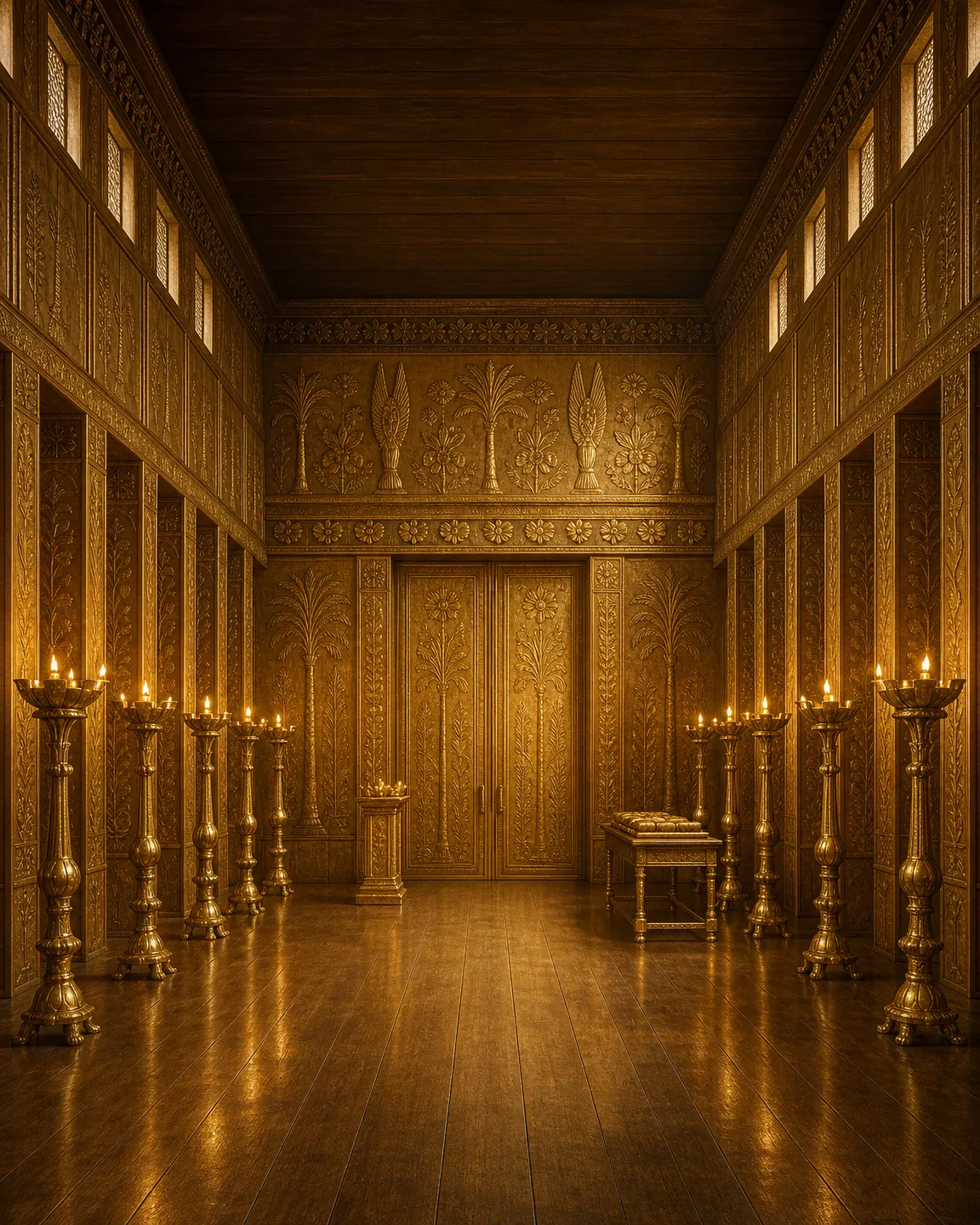
Solomon also made all the furnishings for the house of the LORD:
the golden altar;
the golden table on which was placed the Bread of the Presence;
the lampstands of pure gold in front of the inner sanctuary, five on the right side and five on the left;
the gold flowers, lamps, and tongs;
Vessels and doors
the pure gold basins, wick trimmers, sprinkling bowls, ladles, and censers;
and the gold hinges for the doors of the inner temple (that is, the Most Holy Place) as well as for the doors of the main hall of the temple.
So all the work that King Solomon had performed for the house of the LORD was completed.
1 Kings 7:51
Then Solomon brought in the items his father David had dedicated—the silver, the gold, and the furnishings—and he placed them in the treasuries of the house of the LORD.
Pray
God gave Huram “great skill, understanding, and knowledge for every kind of bronze work,” and he used it for the house of the LORD until it was finished. Thank God for the gifts and skills He has given you. Lord, let me give You my best work, not my leftovers. Help me finish faithfully what You set before me, as “all the work that King Solomon had performed for the house of the LORD was completed.” Amen.
You’ve experienced
1 Kings 7
0 of 22 chapters read
A verse to carry with you
The pillar to the south he named Jachin, and the pillar to the north he named Boaz.
1 Kings 7:21
or swipe left